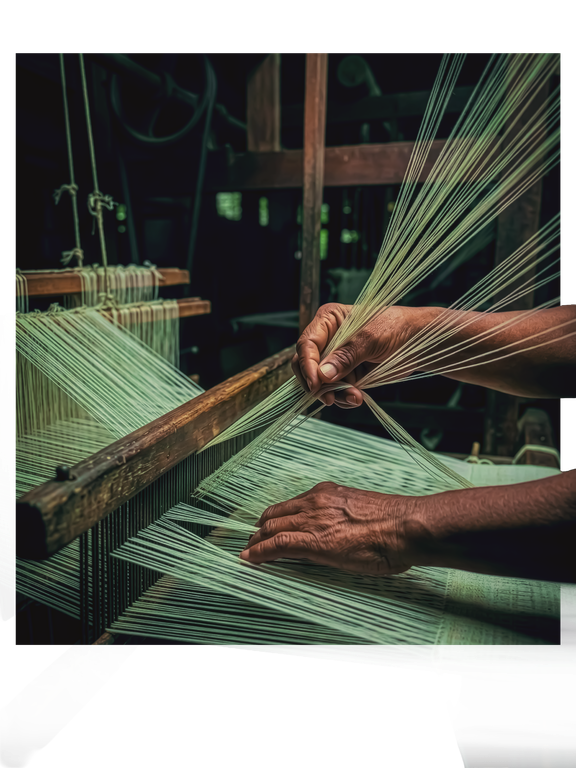

The story of Sri Lankan handloom is almost inseparable from the story of the island itself.
According to the Mahawamsa, or the “Great Chronicle,” when Prince Vijaya stepped ashore in 543 BC, he first saw the Yaksha princess Kuweni spinning soft threads of cotton on her spinning wheel—and it is since then that generations of Sri Lankans have passed along the tradition of the loom.
Traditional Sri Lankan handloom is known for its vibrant colours, bold geometric designs, and the use of techniques like “ikat” (resist dyeing) and dobby weaving to create intricate patterns.
Yarn was home-spun from cotton cultivated in chenas, while natural dyes were drawn from seeds, flowers, bark, and roots. Stylized motifs of the mythical serpent-like “kobo” and the “salalihiniya” bird were immortalized at the loom—alongside the sun, moon, stars, peacocks, and elephants. Geometrical patterns were also common, such as the “katuru mala” (crossed petals), “bota pata” (two triangles apex to apex), and “mal petta” (geometrical flower petals).
The “pit loom”, a simple and inexpensive loom, is central to the Dumbara weaving tradition—producing practical woven pieces with designs drawn from indigenous traditions. Among the important motifs are “Diyarella” (a design representing waves rising and falling in a gentle breeze) and “Adara kondu” (straight line motifs known as “iri kondu” when found in textiles).
Sri Lanka has always been a predominantly Buddhist nation, and among the practices associated with religion and religious leaders is the tradition of “Kathina robes” worn by Buddhist priests—a practice closely tied to handloom production that has helped sustain the craft through centuries of religious observance. This sacred connection gave handloom weavers not just an economic role, but a spiritual and community identity—making their craft an act of devotion as much as production.
A new generation of Sri Lankan designers is seeking to revive the face and future of the handloom industry by combining old designs with bold colours, textures, and materials. Bold-coloured handloom garments, bridal sarees made with silk and polished cotton, vibrant kaftans, sarongs, shawls, and hand-woven tapestries have become highly sought after both locally and internationally.
Leading fashion designers and interior decorators now use Sri Lankan handloom designs and products in creating new fashion statements—from handloom curtains and rugs to bed linen sold under leading labels across the world. With growing demand for environmentally sustainable and fair-trade handmade products, the Sri Lankan handloom industry holds a greater opportunity for global expansion.
If you were to visit a handloom workshop, you would see meditative artists weaving on their handlooms—artisans, mostly elderly ladies, coordinating eyes, hands, feet, and mind in perfect harmony, producing beautiful yards of colourful textile. The life of these cotton textiles begins with the dyeing of 100% cotton yarn into vibrant colours.
Key tourist destinations and experiences:
Kandy — villages scattered around the hill capital are home to skilled weavers continuing to use traditional looms with classic Kandyan motifs and bold geometric patterns, conveniently combined with visits to the Temple of the Tooth.
Matale district — a significant hub where weaving villages produce high-quality sarees, sarongs, and home linens. A "Matale Loom Tour" can involve visiting several workshops to compare different styles and techniques, set against the backdrop of lush spice gardens.
Thalagune and Dumbara — famous tourist destinations that resemble traditional art and craft values, alongside reed works in Pasyala and brassware in Pilimathalawa for a broader craft trail.
Laksala (Lakpahana Handicrafts) — the state-run crafts emporium offering a curated collection of handloom products from across the island, ensuring quality and authenticity for visitors seeking guaranteed souvenirs.
Sri Lankan handlooms have been evolving through wars, trading, golden ages, the caste system, colonisation, and everything else that shaped the island and its people. Caught between their threads is the memory of a beautiful place in the tropics, and the story of its oldest textile craft, kept alive through generational knowledge.