Queens without a kingdom, still drifting above the jungle in gold and cloud.
Before the heat arrives, before the tour buses and the sound of footsteps break the silence, Sigiriya rises out of the central Sri Lankan landscape like a memory half-remembered rather than fully seen. In the early morning light, when mist still clings to the treetops and the earth has not yet surrendered to the sun, the rock appears almost unreal.
It is neither entirely stone nor entirely shadow, but something in between — suspended, floating above the green canopy like an ancient thought that refuses to dissolve.
From a distance, it feels less like a fortress and more like a presence. Something that watches rather than merely exists. A monolith shaped not only by geological time but by human desire, ambition, and imagination. For over fifteen centuries, it has stood here, witnessing the rise and collapse of kingdoms, the shifting of belief systems, and the slow layering of history upon itself.
Empires have come and gone. Forests have expanded and retreated. Yet Sigiriya remains, unchanged in its silence, as if guarding something that has never been fully revealed.
The Lonely Damsels
This story, however, is not about Sigiriya as a fortress or a king’s ambition carved into stone. It is about something more elusive. Something that survives not in architecture alone, but in paint and air and imagination.
It is about women.
Women who have survived for more than 1,500 years, not in flesh, but in colour and form, painted into the rock as if they belong not to history, but to the sky itself.
To the Summit
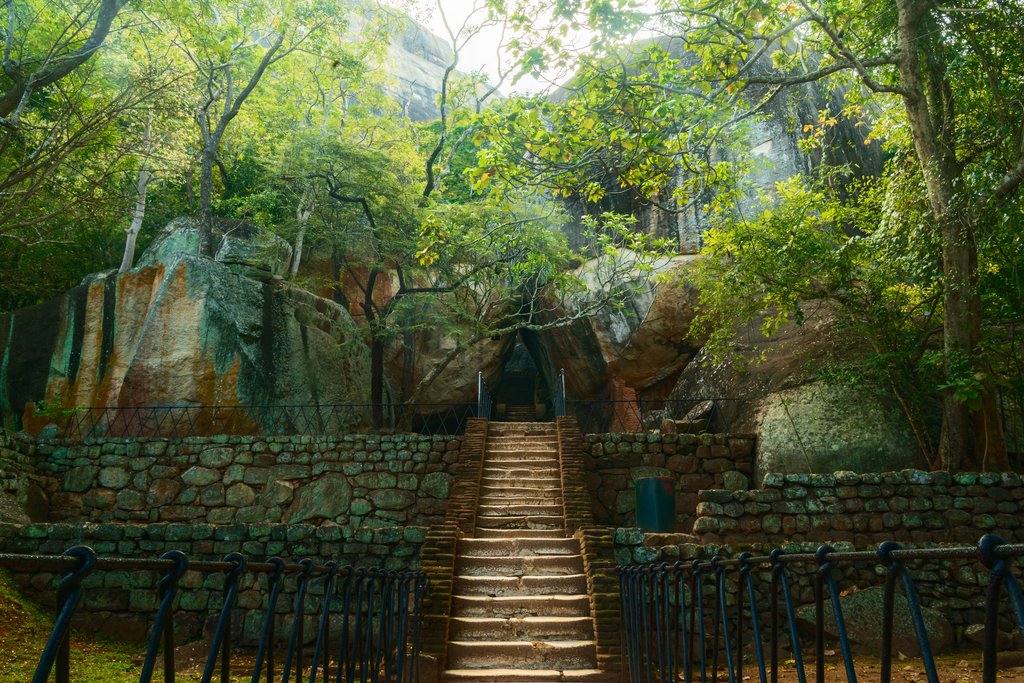
As the ascent begins, the world at the base of the rock feels deceptively gentle. Water gardens stretch outward in geometric precision, their ancient design still whispering of a civilisation that once understood balance between nature and structure. Pools reflect the shifting sky.
Stone pathways lead inward, guiding the visitor through a landscape that once belonged to royalty but now belongs to memory.
Yet even here, before the climb truly begins, there is already a sense of transition — as if one is leaving behind the present and entering a space where time behaves differently.
Then the climb begins in earnest.
The stairways rise sharply against the rock face, narrowing as they ascend. Stone steps worn smooth by centuries of passage lead upward, while iron walkways now cling to the cliffside, allowing modern visitors to follow the same path once taken by ancient courtiers and guardians. The heat intensifies as height is gained, and the air changes subtly, becoming thinner, sharper, as if the mountain itself is drawing the traveller closer to something hidden.
Beneath the rising rock face, lion-shaped stone formations emerge, their massive paws still anchored in place long after the body of the creature has disappeared into time. They are silent now, yet their presence remains powerful, suggesting a threshold once guarded by myth and authority.
Beyond them, the climb becomes more vertical, more exposed to wind and sky, and the landscape below begins to shrink into abstraction — rivers like threads of silver, trees like scattered brushstrokes, human voices dissolving into distance.
It is here, somewhere between earth and sky, that the feeling begins to shift.
Something is waiting above.
Not in a physical sense, but in atmosphere, in expectation, in the subtle pressure of history that seems to accumulate with every step. The wind moves differently at this height. It does not simply pass through the rock; it circulates around it, as if carrying with it fragments of voices that once belonged to another time. The idea of the fortress becomes less architectural and more emotional. One is no longer simply climbing a rock. One is moving through memory.
And then, without warning, they appear.
The women.
The Golden Maidens and the Blue-Lotus Maidens
They are not announced. There is no grand unveiling.
Instead, they emerge quietly from the surface of the rock, as if they have always been there, waiting for the right moment to be seen.
Painted onto the western face of Sigiriya, they float within a band of rock that seems to belong more to sky than to stone. Their presence is unexpected, not because they are hidden, but because they feel alive in a way that defies time itself.
Nobody knows exactly who they were.