
Sansun Therapy
- Featuring Christopher Murray
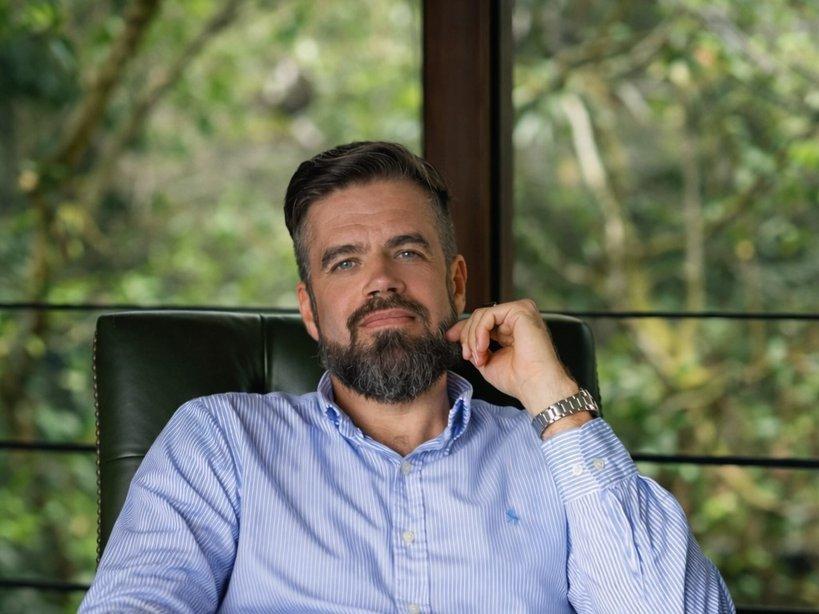
Christopher Murray is a Cognitive Hypnotherapist and NLP Practitioner, and Co-Founder of Sansun Wellness alongside his wife, Naomi. He trained in Cognitive Hypnotherapy with Trevor Silvester at The Quest Institute in London and is a registered member of the National Council for Hypnotherapy (UK).
Naomi specialises in organisational models and life optimisation, and together they have developed Sansun Wellness as a practice focused on cognitive clarity, performance, and sustainable wellbeing.
Christopher’s work centres on behavioural change and high-level performance. He specialises in confidence, anxiety, leadership development, and optimisation, working with capable individuals who want to remove internal limitations that restrict their next stage of growth.
Open about his own neurodivergence, including ADHD and dyslexia, he brings both lived understanding and structured methodology to his practice. He works extensively with analytical, high-processing, and neurodivergent clients, adapting Cognitive Hypnotherapy to align with the way their minds naturally operate.
Sessions are discreet and strategically focused, designed to examine the internal rules and narratives that shape decision-making. His approach is not about adding motivation, but about refining how the mind already operates so that it becomes a strategic asset.
Through Sansun Wellness, Christopher works with both local and international clients in person and online, with a significant client base across the Gulf states, Australia, and the wider Asia-Pacific market, UK and EU.
1. The majority of society bears misconceptions about hypnosis and its methods. How do you shift focus in your client’s perceptions and expedite their recovery by “dissecting old trances” and “de-hypnotising” them from their past?
Most people imagine hypnosis as something dramatic that happens to them. In reality, trance is an everyday occurrence. We all move in and out of absorbed states constantly. Driving and not remembering the journey, replaying a negotiation in your head and reacting before thinking. That is trance.
The individuals I work with are often high-performing and outwardly successful. They do not come because they are failing. They come at inflection points like a leadership decision, a business expansion, a transition in identity, or a recurring pattern in work or relationships they can no longer ignore. Outwardly they are functioning well. Internally they recognise a boundary, a hesitation, or a negative repetition that effort alone is not resolving.
By the time someone walks into my practice, they are already confined to a story about who they are. “I am not that type of leader.” “I always overthink.” “I cannot scale beyond this.” “ I don’t feel right about this.” These conclusions once made sense and over time they become identity.
Cognitive Hypnotherapy works from a simple position: people are not broken. They are responding logically to experience in which the subconscious has created those realities. If those supposed realities are examined and updated, behaviour can shift in a powerful and positive way.
De-hypnotising is not about installing confidence or imposing belief. It is about identifying the invisible assumptions running beneath in the background. When a leader sees that a long-held narrative is simply a construct rather than a fact, clarity replaces friction and then the magic can happen.
At a certain level of success, progress is not about effort, it is about precision and optimisation. When the mind is no longer defending those outdated interpretations, energy becomes available again. This leads to sharper decisions and a defined path to move forward and succeed on the right terms.
2. Many traditional therapy models were intended for neurotypical brains. How has Sansun Therapy specifically adapted the Cognitive Hypnotherapy framework to better serve neurodivergent clients?
Many of the people I work with are not struggling because they lack ability. They are often operating at a high level and the problems occur when their cognitive style does not sit comfortably inside conventional systems.
I am very open about the fact that I am neurodivergent myself. I have ADHD and dyslexia. That has shaped how I think and how I structure sessions. I do not expect clients to slow down, simplify themselves, or disengage their analytical mind to make therapy work.
Many therapeutic frameworks are not calibrated for fast-processing, highly analytical cognitive styles, which can make sessions feel either slow or conceptually imprecise.
Highly analytical ADHD and autistic clients often process differently. They may notice inconsistencies quickly and like to move between ideas at speed. Often they need internal coherence before they can commit to change.
Whilst ADHD and autism are distinct profiles, there are overlaps in how those minds operate in a room. Strong pattern recognition, deep focus and sensitivity to mismatch. When that is respected, our sessions become far more productive.
Cognitive Hypnotherapy offers a broad range of tools. We can examine internal rules, shift perspective rapidly, and move between structured dialogue and experiential work without losing clarity. For my analytical clients, that flexibility matters. They know they are not being bypassed and their intelligence is being engaged.
The aim is not to make someone more typical. It is to refine how their mind already works so that it becomes a strategic asset rather than an internal obstacle. When cognitive strengths are aligned properly, performance improves and obstacles become easier to navigate.
3. After acquiring the skills and knowledge necessary to perfect your art, was there a particular reason you chose Sri Lanka for your therapy practice?
The decision was deeply personal as well as strategic.
Naomi, my wife and co-founder, is a dual Sri Lankan citizen, so the connection to the country has always been part of her story. Over time, we felt increasingly drawn to building something here rather than simply working within larger international systems.
For us, Sri Lanka represented a reset. It allowed us to reconnect with ourselves and re-evaluate how we wanted to live and build. From that foundation, we have developed our ideas around mental health, performance, and optimisation in a more intentional way.
Naomi specialises in organisational models and life optimisation. My work focuses on cognitive clarity and behavioural change. Sri Lanka has given us the space to further develop those ideas in an environment that supports reflection and precision.
The practice operates discreetly and serves both local and international clients, in person and online. Our client base spans South Asia, the Gulf states, Australia, the wider Asia-Pacific market, as well as the UK and EU. Sri Lanka reflects an international footprint and has enabled us to build a practice that is grounded, connected, and digitally scalable.
For us, Sri Lanka was not simply a relocation. It placed us closer to nature in a way that changes how you think. The diverse landscape of jungle, hills and coast have given us a different perspective. The wildlife we see daily is awe inspiring and from that foundation, we have expanded beyond the physical practice into digital platforms, courses, and even a new hypnosis app ready to launch.
In our two years on the Island we have experienced so much more than we anticipated, and are still learning valuable lessons. It truly is a hybrid of raw beauty and unexpected challenges, all of which have strengthened our relationship as a team, shone light on new possibilities and inspired us time and time again.