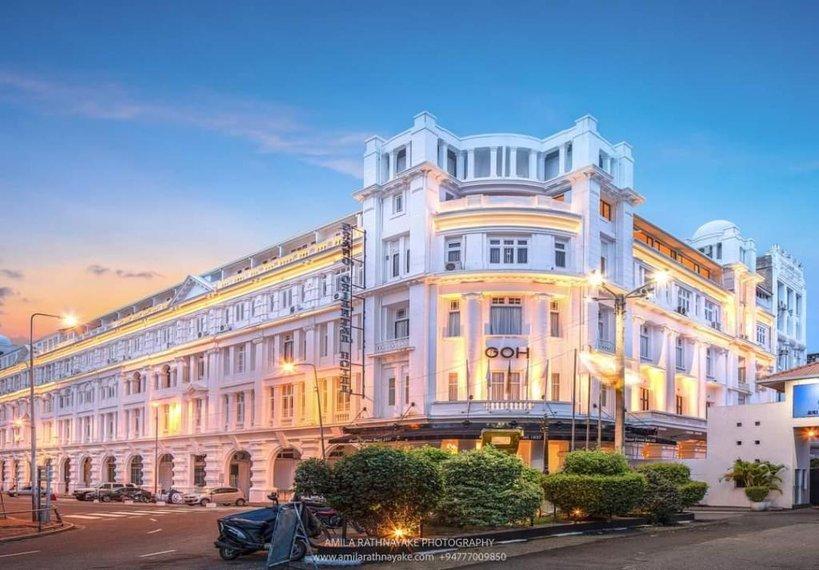

Grand Oriental Hotel
A historical and culturally significant treasure in Sri Lanka’s hospitality industry.
The 19th century Dutch Governors castle was this building overlooking the harbour and this land was called Ceylon at that time. In 1837 then King of England, William IV wanted to construct army barracks and the constructions were completed in the same year, which truly was a magnificent effort made by the British architects and engineers. This endeavor was possible due to the untiring efforts of the Governor of Ceylon, Sir Wilmot Horton and Commander of the British Army in Ceylon, General John Wilson.
Once British forces consolidated their position, military forces left the Island and the buildings were handed over to local authorities. This was the turning point, rather, the birth of the ‘Hostelry’ by a private entrepreneur. On November 5th 1875, doorways were open to the public. It was officially open to everyone as a hotel on that date and was named ‘Grand Oriental Hotel’ managed by the company named ‘Colombo Hotels Company Limited’.
Architect Mr. C. E. Willims who drew the plan for Colombo General Hospital prepared the blueprint for converting the Military Barracks into a hotel; further improvement was brought in by Architect R. Smith, who carried detailed plans to reconstruct the building into a luxurious hotel.
In an article which appeared in the ‘Ceylon Observer’ on September 6th 1875, the following was written;
“Only hotel in Colombo under European management, visitors will find unusual convenience in this establishment, being situated in the midst of the mercantile and shipping business in the fort and combining the comforts and cleanliness of the best hotels with moderate charges. It possesses a large table d’hot room, sitting room, billiards room, Wines, Beers, and many more of the best and purest quality.”
The Grand Oriental Hotel, more popularly known as the GOH, was referred to thus in the book, “Twentieth Century Impressions of Ceylon”; The GOH, as it is familiarly known far and wide was the first of the modern type of imposing hotels built in the east.
GOH begun to prosper from the beginning of the 20th century and almost every person of reckoning wanted a ‘piece of the hotel’ and begun buying large slices of shares. At the beginning only 500 shares were issued and these were snapped in next in no time. On the opening day of the hotel, 5th November 1875, a further 500 shares were offered and applications had to be closed by 10th November 1875 due to very high competition.
GOH was flying very high with well-respected English personalities such as Mr. W.P.S Saunders in 1901, who has close connections with British government looking after British Royalty where’ Prince of Wales’ visited Ceylon. In 1904 Mr. G. Loosen succeeded Mr. W.P.S Saunders and continue the upliftment of the hotel. The hotel was maintained in the highest traditions of hospitality at international high-class level. Long before star-class hotels were built in this Island, the Grand Oriental Hotel monopolized the hospitality industry, not only due to its locality – being just across the Colombo Port but because of the cuisine and service accorded to its visitors/customers fro all over the world.
At the beginning there were 154 luxury and semi- luxury rooms in this hotel for occupants and “20th Century Impressions of Ceylon” once again said;
“Upstairs there are numerous suites and private apartments commanding fine views of the coast and the sea’, One of the largest, best appointed and coolest in the east. It’s dining room filled with electric lights and fans and capable of seating 300 persons at a time while the cosine is under the control of experience chef.”
Offices of the Manager and the front office were situated on the ground floor. ”Palm Court”, a relatively small social gathering type of place with a garden was filled with various types of flowering and foliage plants and guest used to meet here for tea or coffee.
The main garden of the hotel was beautifully landscape and illuminated with colored bulbs in the evenings. It is said that there was not a single day without a party in this garden. During the mid of 20th century, weddings were hosted in this famous garden. 20th century impressions of Ceylon” quoted; “An exceedingly pleasing feature of the establishment is the tropical garden where guest may rest in charming surroundings while listening to the hotel band.”
The GOH also had an exclusive ‘Roof-Top” restaurant where foreigners use to assemble for a dine and wine, and some used the open space for sunbathing.
As time goes by, it was a fashion among the elite society to lunch of dine at the GOH as a matter of prestige. Fashion shows, Dances and other various functions were hosted at the GOH as a matter of prestige. Some of the Colombo elites bench mark the furniture and crockery of the hotel for grace their respective residences.
Due to labour issues in 1953, the hotel went through a bad patch and the proprietor of the GOH, Mr. Sam De Vos, decided to sell the property to the Bank of Ceylon — BOC. With the ownership change, the foreign management was changed and local entrepreneurs were managing it but unfortunately, it was not a smooth operation and they had to move out. Trade Unions and BOC also had issues and the Government had to intervene to solve the problems. Finally, BOC changed the name to “Hotels Colombo (1963) Limited” due to previous owners’ objections for using the GOH brand and that led to brand the hotel as “Taprobane”.
This was the period that hotel size was reduced and the world renown Architect, Mr. Geoffrey Bawa, was invited and as a result, Habour room, Baquet halls, etc commenced its operations. At the same time, the first ever night club in a hotel in Ceylon, the “Blue Leopard Night Club” begun its operations.
The legacy continues, not only for famous cuisine, services and homely comforts to its travellers but because it became a stopping place for foreign Royalty and dignitaries: Lord Mountbatten, Dr. Jose Rizal – the Philippine National Hero, Anton P Chekhov, Prime Ministers -Chou En Lai of China, Nehru of India, Marshal Tito of Yugoslavia, Archbishop Makarios of Cyprus and many more were welcome on red carpet to GOH.
Apart from the foreign signatories, many other significant events and milestones were achieved by the GOH. The first meeting of the “Ceylon Cricket Board, Rugby Society of Ceylon, Miss Lanka, Mss Ceylon, Miss Working Girl, and many such events were hosted one after other.
GOH has gone a real “roller coster ride” during last 150 years with an untouchable legacy and celebrated its 150 years birthday on 5th of November 2025. GOH logo tag line is self-explanatory for such a challenging journey. The tag line: “GIANT YET LIVING”, is in good hands as of now with new Board of Directors appointed by the owners – BOC and cursing in yet challenging waters. It is one of the greatest heritage sites that needs re-positioning to bring back the past glory.
We have already started that daunting task and with the X-Mas cake mixing ceremony held on 16th October 2025 followed by birthday celebrations on the 5th of November, many entertainment events, World famous Blue Leopard Night Club, X-Mas celebrations, 31st December celebrations, Overnight Pirith ceremony and staff get-together, are on the calendar of events.